How to Choose Bedding Fabrics
Bedding labels are full of numbers and terms that rarely explain how a sheet will actually feel. Understanding fibre, weave and weight tells you far more than thread count, and helps you choose bedding that suits how warm you sleep.

Bedding is one of the few things in a home that touches you for a third of every day, yet most people buy it by colour and price, with a vague sense that a higher thread count is better. In practice, how a sheet feels depends on three things: the fibre it is made from, the weave that turns that fibre into fabric, and the weight or density of the finished cloth. Getting these right for your sleep temperature and preferences makes more difference than any single label claim.
Fibres at a glance
| Fibre | Feel | Temperature | Care | Good for |
|---|---|---|---|---|
| Cotton (long-staple) | Soft, familiar, consistent | Neutral; depends on weave | Easy; tolerates warm washes | Most people, year round |
| Linen (flax) | Textured, softens with washing | Cool, very breathable | Easy, but creases; avoid over-drying | Warm sleepers, summer, relaxed look |
| Lyocell (often sold as Tencel) | Very smooth, silky, drapey | Cool, wicks moisture | Gentle wash, low heat | Warm sleepers who like a smooth feel |
| Brushed cotton / flannel | Fuzzy, cosy | Warm | Easy; may pill over time | Winter, cold bedrooms |
| Cotton jersey | Stretchy, like a T-shirt | Neutral to warm | Easy | Children's beds, casual comfort |
| Silk | Smooth, slippery | Regulates well, light | Delicate; hand or gentle wash | Pillowcases, occasional luxury |
| Polyester and blends | Smooth, can feel synthetic | Can feel warm and less breathable | Very easy, quick-drying, few creases | Budget, guest rooms, quick turnaround |
Not all cotton is equal
Cotton quality depends mainly on staple length, the length of the individual fibres. Long-staple and extra-long-staple cottons, such as Egyptian, Pima or Supima, can be spun into finer, stronger yarns with fewer loose fibre ends. This produces fabric that feels smoother, pills less and lasts longer. Be wary of vague labels: "Egyptian cotton" on its own does not guarantee long-staple fibre, so look for details on the fibre and weave, or certification of the fibre's origin where offered.
Lyocell, viscose and "bamboo"
Lyocell is a regenerated cellulose fibre made from wood pulp in a closed-loop solvent process. It feels smooth and cool and handles moisture well. Bedding sold as "bamboo" is usually bamboo viscose, another regenerated cellulose fibre; it is soft and drapey, but the processing is chemical and environmental claims vary, so read labels carefully rather than assuming it is a natural fibre in the same sense as linen.
Weave: percale, sateen and others
The same cotton can feel completely different depending on how it is woven.
- Percale: a plain weave with one weft thread passing over one warp thread and under the next. It produces a crisp, matt, breathable fabric that feels cool, like a well-ironed shirt. Percale often softens with washing and is durable. Good for warm sleepers.
- Sateen: a weave where threads pass over three or four threads before going under one. The floating threads create a smooth surface with a gentle sheen and a heavier drape. Sateen feels silkier and slightly warmer than percale, but the floats can snag on rough skin, jewellery or pet claws.
- Twill: a diagonal weave, durable and soft, more common in duvet covers and flannel than in sheets.
- Jacquard and damask: patterned weaves made on a jacquard loom, often a combination of sateen and other weaves. Decorative and usually heavier.
- Seersucker and waffle: textured weaves that hold the fabric slightly away from the skin; seersucker is cool in summer, waffle often used for blankets.
The truth about thread count
Thread count is the number of warp and weft threads in one square inch of fabric. It became a marketing shorthand for quality, which led to inflated figures. A few points help make sense of it:
- There is a sensible range. Percale tends to be comfortable around 200–400; sateen around 300–600. Within these ranges, quality of fibre and finishing matters more than the number.
- Very high counts can mislead. To reach 800 or 1,000, manufacturers may count multi-ply yarns (several thin strands twisted together) as multiple threads. The result can be heavy and less breathable rather than finer.
- Linen does not use thread count. Linen yarns are thicker, so counts are naturally low and not useful for comparison. Weight is used instead.
- Compare like with like. A 300 thread count long-staple percale usually feels better and lasts longer than a 600 thread count sheet made from short fibres.
Weight: GSM for linen and heavier fabrics
Fabric weight is given in grams per square metre (GSM). It is especially useful for linen, where thread count is rarely quoted.
| Linen weight | Feel | Use |
|---|---|---|
| Under 140 GSM | Light, airy, can feel thin | Summer sheets, very warm climates |
| 140–190 GSM | Medium; the most common range for bed linen | Sheets and duvet covers year round |
| Over 190 GSM | Heavier, more substantial drape | Duvet covers, throws, cooler rooms |
For cotton, weight is less often listed, but a heavier sheet generally feels more substantial and warmer, while a lighter sheet feels cooler and dries faster.

Duvets and togs
A duvet's warmth is measured in tog in the UK and many other countries. A higher tog means more insulation. Tog does not measure weight; a light down duvet can be warmer than a heavier synthetic one.
| Tog | Season | Who it suits |
|---|---|---|
| 3–4.5 | Summer | Warm bedrooms, warm sleepers |
| 7–9 | Spring and autumn | Moderate rooms |
| 10.5 | All year | The most common single choice |
| 13.5–15 | Winter | Cold rooms, people who feel the cold |
| All-season (4.5 + 9) | Use separately or together | Households who want flexibility |
Duvet fills fall into two groups. Natural fills such as down, feather-and-down and wool are breathable and handle moisture well; down is light for its warmth. Synthetic fills such as hollowfibre and microfibre are easier to wash at home and are often chosen by people sensitive to feathers. Couples with different temperature preferences can use two single duvets on one bed.
Sizing: get the fit right
Bedding sizes follow the mattress, and they vary between regions. Check the label rather than the name.
- Fitted sheets: measure the mattress depth, including any topper. Standard fitted sheets suit around 25–30 cm (10–12 in); deeper mattresses need deep-pocket sheets of 35–40 cm (14–16 in).
- Duvet covers: in the UK, a double cover is typically 200 × 200 cm, a king 230 × 220 cm and a super king 260 × 220 cm. European sizes differ, often 200 × 200 cm or 240 × 220 cm for doubles.
- Pillowcases: UK standard is around 50 × 75 cm; European square cases are typically 65 × 65 cm or 80 × 80 cm.
A slightly oversized duvet on a large bed hangs more generously and stops cold air entering at the sides. For bed sizes, see our bedroom layout guide.
Layering through the seasons
Instead of one heavy duvet, many people find layers easier to adjust:
- Summer: linen or percale sheets, a 4.5 tog duvet or just a top sheet and a light cotton blanket.
- Spring and autumn: a medium tog duvet with a waffle or cotton blanket folded at the foot.
- Winter: brushed cotton or sateen sheets, a higher tog duvet and a wool blanket or throw.
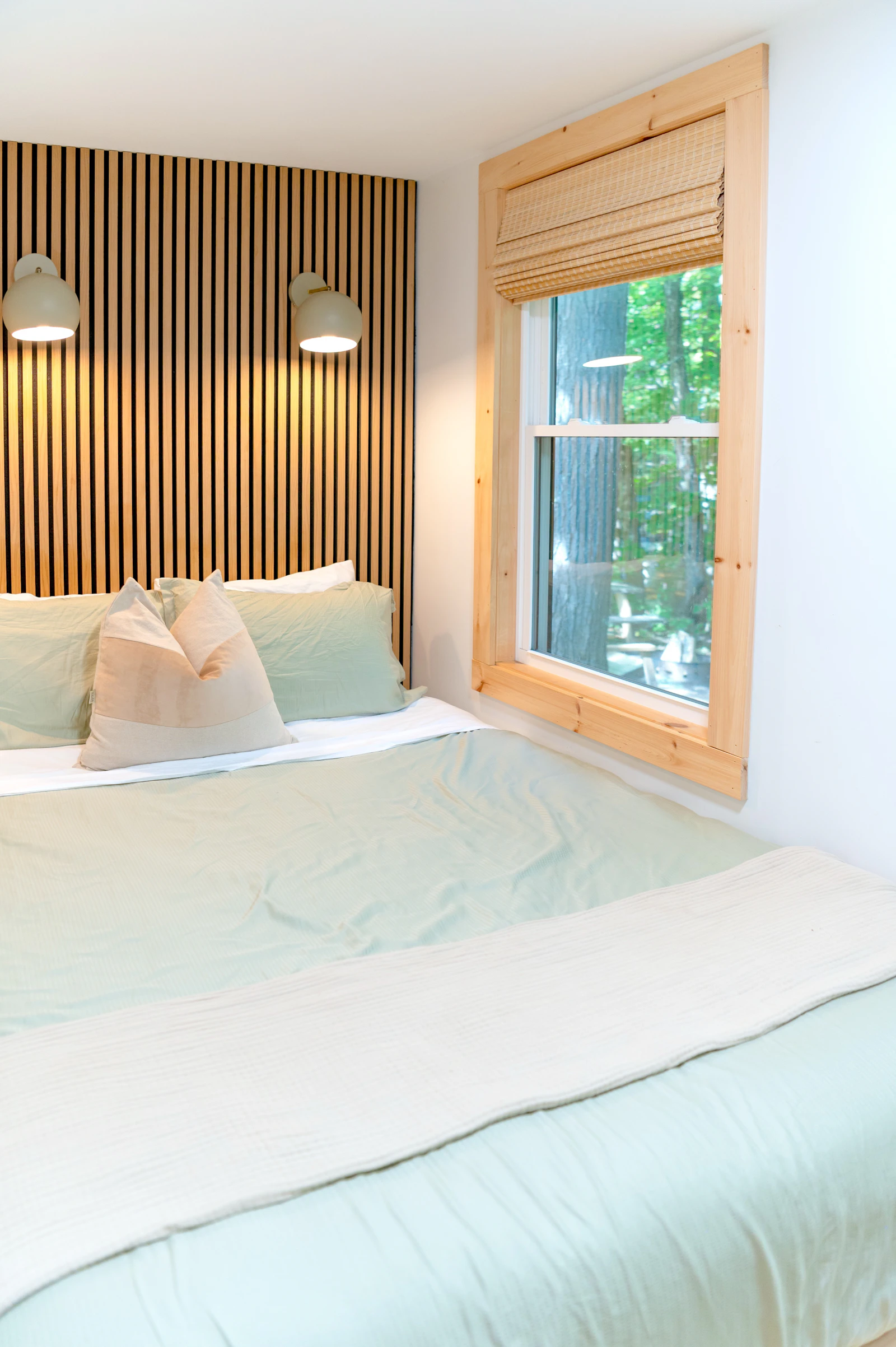
Layering also adds visual interest. A blanket, a throw folded across the lower third of the bed and two or three pillows in related tones create a finished look without many decorative cushions. Our guide to designing a calm bedroom explains how bedding fits into the wider room.
Pillows and protectors
Bedding is only as comfortable as what lies beneath it. Pillows should support the head so the neck stays roughly in line with the spine, which means the right loft depends on how you sleep:
- Side sleepers usually need a firmer, higher pillow to fill the space between the shoulder and the head.
- Back sleepers tend to suit a medium loft.
- Front sleepers generally prefer a soft, low pillow, or none at all.
Pillow fills mirror duvet fills: down and feather are mouldable and light; synthetic fibre is easy to wash; memory foam and latex hold a fixed shape. Mattress and pillow protectors are worth having with any bedding. They take spills and sweat, can be washed regularly, and help keep the mattress and pillows clean between their own, much less frequent, cleaning.
Colour, pattern and labels
White and pale neutral bedding is popular for good reasons: it can be washed warm without fading, it is easy to mix and match, and it makes a bedroom feel fresh. Darker and saturated colours can fade with frequent washing and drying in sunlight, so wash them inside out at cooler temperatures. Woven patterns, such as stripes or checks woven into the fabric, tend to keep their definition longer than printed ones.
Labels can help you compare products. Certifications such as OEKO-TEX Standard 100 indicate that a textile has been tested for certain harmful substances, while GOTS covers organic fibre content and processing criteria. They say nothing about comfort or durability, so use them alongside fibre, weave and weight rather than instead of them.
Care that makes bedding last
- Wash before first use to remove finishes and soften the fabric.
- Follow the care label for temperature. Many cotton sheets can be washed at 40 °C for regular use, and some at 60 °C. Lyocell and silk usually need cooler, gentler washes.
- Do not overload the machine. Bedding needs room to move to rinse properly and avoid twisting.
- Use detergent sparingly. Excess detergent and fabric softener can build up and make fabric feel heavy or less absorbent.
- Dry gently. Line drying or a low tumble-dry setting reduces shrinkage and wear. Remove linen while slightly damp to limit creasing.
- Rotate two or three sets so each set rests between uses and wears more evenly.
- Store in a cool, dry, breathable place, not in plastic, which can trap moisture.
Cotton can shrink a few per cent in the first washes, especially at high temperatures. Allow for this when choosing fitted sheets for a deep mattress.
Common mistakes
- Buying by thread count alone. Fibre and weave decide feel and durability.
- Choosing sateen as a hot sleeper. Percale or linen is usually more comfortable.
- Fitted sheets that are too shallow. Measure the mattress with its topper.
- A single heavy duvet for the whole year. Layers or an all-season duvet are more adaptable.
- Washing everything hot. It shortens the life of delicate fibres and can cause shrinkage.
- Overusing fabric softener. It can coat fibres and reduce breathability.
Bedding checklist
- Decide how warm you sleep and how warm the room is.
- Choose a fibre: cotton for versatility, linen or lyocell for cooling, brushed cotton for warmth.
- Choose a weave: percale for crisp and cool, sateen for smooth and drapey.
- Ignore extreme thread counts; aim for 200–400 percale or 300–600 sateen.
- For linen, check weight: 140–190 GSM is a balanced choice.
- Pick a duvet tog for the season, or an all-season set.
- Measure mattress depth and check regional sizes.
- Wash before use, follow care labels and rotate sets.
Choosing bedding is easier once you know what you like to feel. If possible, touch fabric samples and notice whether you prefer crisp or smooth, cool or cosy. That preference, more than any number on the packet, should guide the choice. If you are furnishing a spare room, our guest bedroom ideas suggest practical, easy-care bedding for visitors.
Frequently asked questions
Is percale or sateen better?
Neither is better; they feel different. Percale has a one-over, one-under weave that feels crisp, cool and matt, which suits people who sleep warm. Sateen floats more threads on the surface, so it feels smoother, drapes more and has a slight sheen; it tends to feel a little warmer and can be more prone to snagging.
What is a good thread count for sheets?
For cotton percale, around 200–400 is a good range; for sateen, 300–600. Higher numbers are not automatically better. Very high counts are often achieved with thinner, multi-ply yarns, which can make a sheet heavier and less breathable without improving quality. Fibre length and weave matter more.
What tog duvet should I buy?
In the UK tog system, 4.5 tog suits summer, 10.5 tog is a common all-year choice and 13.5 tog suits cold rooms or people who feel the cold. All-season duvets combine a 4.5 and a 9 tog that can be used separately or clipped together for 13.5. Choose a lighter duvet if you sleep warm.
Is linen bedding worth it?
Linen is breathable, absorbs moisture well and becomes softer with washing, which many people find comfortable in warm weather. It has a textured, relaxed look and creases easily. It usually costs more than cotton, but good linen is durable and can last many years with proper care.
How often should bedding be washed?
Many households wash sheets and pillowcases every week or two, and more often in hot weather or during illness. Duvet covers can follow the same schedule. Duvets and pillows themselves need washing far less often; follow the care label, and use a protector to extend the time between washes.
Why do new sheets feel stiff?
New sheets often have finishing treatments and sizing from manufacturing. Washing them before first use removes much of this and softens the fabric. Linen in particular becomes noticeably softer after several washes.
Measurements and rules of thumb in this guide are starting points; always check your own room, local building rules and manufacturer instructions. Images are illustrative, from Unsplash. Read how we research and update our guides in our Editorial Policy, and tell us if you spot an error.