Rug Size Guide for the Living Room (and Beyond)
A rug that is too small is one of the most common reasons a room looks unfinished. This guide explains how to size a rug for the way your furniture is arranged, with standard sizes, border rules and the materials that suit each room.
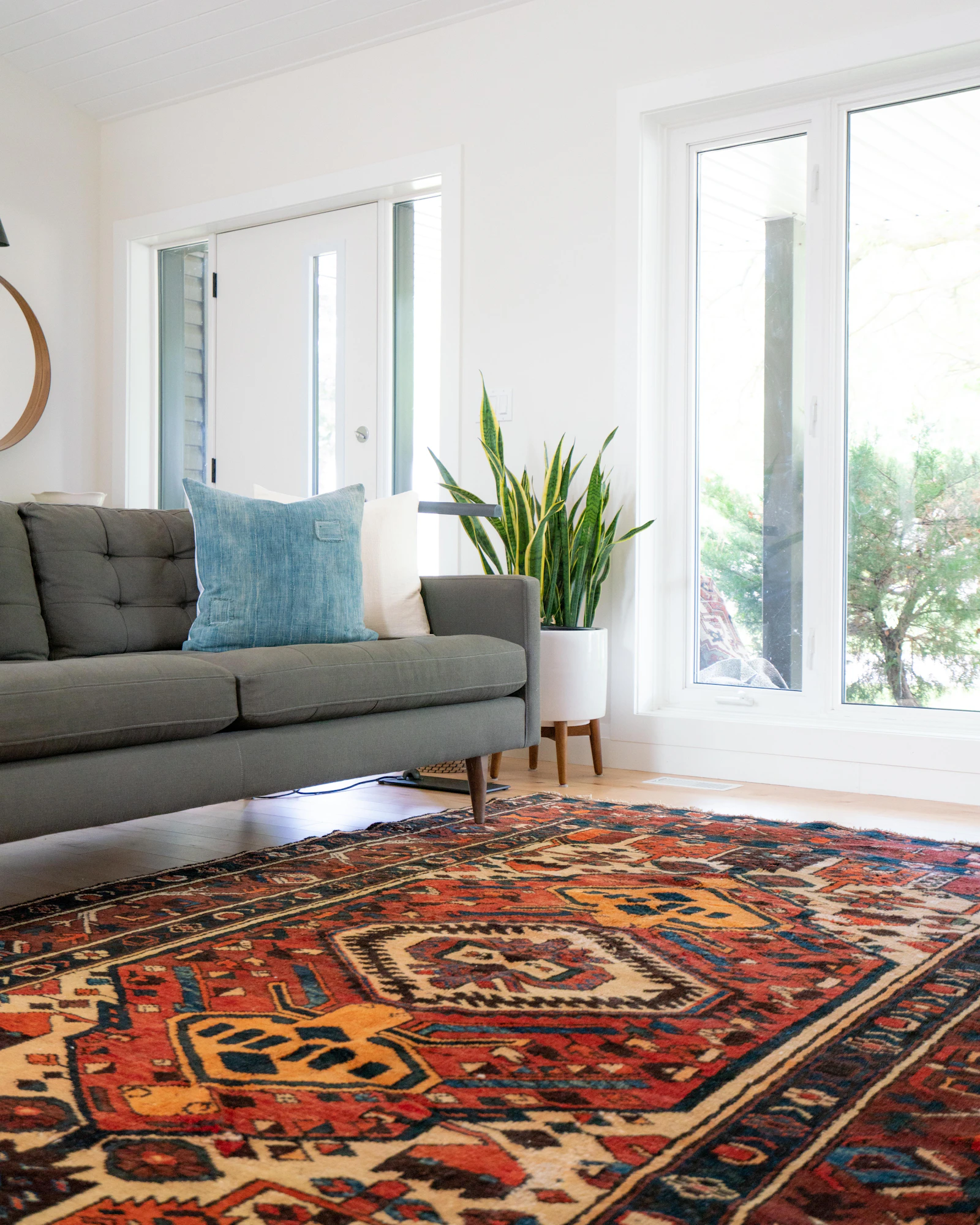
A rug does two jobs in a room. It softens the floor underfoot and in sound, and it groups furniture into a coherent arrangement. The second job is the one most people overlook, and it is the reason a rug that is too small can make an otherwise well-furnished room feel scattered. The size of the rug should follow the furniture, not the other way round.
Below you will find the three main placement methods, standard sizes in metric and imperial, rules for dining rooms, bedrooms and hallways, and practical notes on materials and pads. If you prefer to work from your own measurements, the rug size calculator applies the same rules automatically.
Three ways to place a living room rug
The furniture arrangement determines the rug size. Measure your seating group first, ideally after you have settled the layout using our guide to arranging living room furniture.
1. All legs on the rug
The sofa, the armchairs and the coffee table sit entirely on the rug. This creates the most unified, generous look and works especially well when the seating floats in the middle of a large room or an open-plan space, because the rug effectively becomes the floor of the living zone. It needs the largest rug: the rug should extend at least 15–20 cm (6–8 in) beyond the furniture on every side so legs do not sit right on the edge.
2. Front legs on the rug
The front legs of the sofa and chairs rest on the rug; the back legs sit on the floor. This is the most versatile method and suits most living rooms where the sofa is against a wall. Aim for the rug to start about 15–20 cm under the front of the sofa, so the legs are clearly on it rather than balanced at the edge. Use the same depth under each chair to keep the arrangement consistent.
3. Floating rug
Only the coffee table sits on the rug and no seat touches it. This works in small rooms where a larger rug would hit the walls, or for a deliberately layered look over carpet. The rug should still be wider than the coffee table by a good margin, roughly the length of the sofa minus 30–40 cm, and centred on the seating. A floating rug that is barely bigger than the table looks like a mat, which is the most common sizing mistake.
How to measure for a living room rug
- Measure the full width of your seating arrangement, from the outside of one arm to the outside of the furthest piece on the other side.
- Add 30–40 cm (12–16 in) to that width so the rug extends 15–20 cm beyond each end.
- For depth, decide on the placement method. For front legs on, measure from 15–20 cm under the sofa front to 15–20 cm under the front of the chairs opposite. For all legs on, measure from behind the sofa back legs to behind the chairs, plus 15–20 cm on each side.
- Check the border: subtract the rug size from the room size. Ideally, 30–45 cm (12–18 in) of floor should remain visible on each side.
- Round to the nearest standard size. If you fall between two, the larger is usually the better choice, unless it breaks the border rule.
- Mark the outline on the floor with masking tape and check door swings: a thick rug can stop a door opening if it extends into the arc.
Standard rug sizes
Rugs in Europe and the UK are usually sold in metric sizes, while rugs made for the US market use whole feet. They are close but not identical, so always check the actual centimetre dimensions before ordering.
| Metric size | Nearest imperial size | Typical use |
|---|---|---|
| 60 × 90 cm | 2 × 3 ft | Doormat, beside a bath or bed |
| 120 × 170 cm | 4 × 6 ft | Floating rug in a small room, under a desk chair |
| 160 × 230 cm | 5 × 8 ft | Small living room (floating or front legs with a two-seater) |
| 200 × 290 cm | 6 × 9 ft (183 × 274 cm) | Most living rooms, front legs on; dining table for four |
| 240 × 340 cm | 8 × 10 ft (244 × 305 cm) or 8 × 11 ft | Larger seating groups, dining for six, king bed |
| 300 × 400 cm | 9 × 12 ft (274 × 366 cm) or 10 × 14 ft | All legs on in a large room, open-plan zones |
| Round 150–200 cm | Round 5–6.5 ft | Round dining table, reading corner, entrance |
| Runner 70–80 × 200–300 cm | 2.5 × 7–10 ft | Hallways, beside a bed, galley kitchen |
If no standard size fits, cut-to-size broadloom with a bound edge is an option. It is common for very large or awkwardly shaped rooms and is often less expensive than oversized woven rugs.
Border rules: how much floor should show?
In a living room, leave 30–45 cm (12–18 in) of bare floor between the rug edge and the walls. This frame of floor makes the rug look intentional; a rug that runs almost to the skirting looks like ill-fitting carpet, while one that stops a metre short looks undersized. In small rooms, a border of 20 cm (8 in) is acceptable.
Try to keep the border similar on opposite sides. It does not need to be identical on all four, but a 20 cm gap on one side and 90 cm on the other usually signals that the rug is in the wrong place or is the wrong shape for the room. Large fixed furniture such as built-in units counts as wall for this purpose.
Dining room rugs
The rule under a dining table is simple: chairs must stay on the rug when pulled out. A chair that catches on the rug edge every time someone sits down is irritating and wears the rug unevenly. Add 60–75 cm (24–30 in) to every side of the table.
| Table size | Minimum rug |
|---|---|
| Round 90–110 cm (4 seats) | Round 220–250 cm or square 240 × 240 cm |
| 80 × 140 cm (4 seats) | 200 × 290 cm |
| 90 × 180 cm (6 seats) | 240 × 340 cm |
| 100 × 240 cm (8 seats) | 250 × 350 cm or 300 × 400 cm |
Choose a flatweave or low pile for dining areas. A low pile lets chairs slide, and crumbs are easier to vacuum out. Busy patterns are more forgiving of spills than solid pale colours.
Bedroom rugs
In a bedroom, the rug is there to give a soft first step out of bed. There are three common approaches:
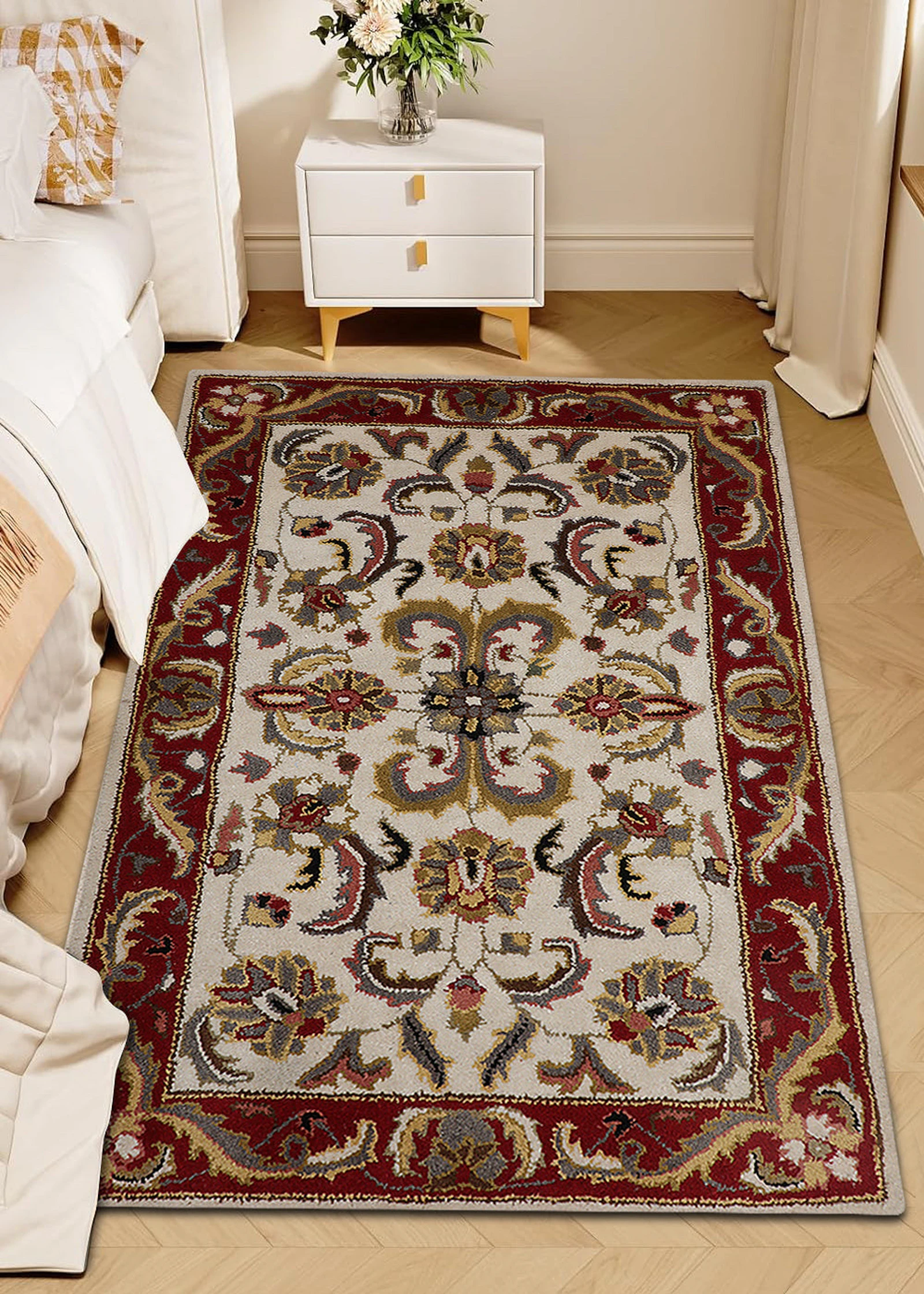
- One large rug under the bed: position it so it starts just in front of the bedside tables, roughly a third of the way down the bed, and extends 45–60 cm (18–24 in) beyond the sides and foot. For a double bed this usually means 160 × 230 cm or 200 × 290 cm; for a king, 240 × 340 cm.
- Two runners: one on each side of the bed, about 70–80 cm wide and slightly longer than two-thirds of the bed length. Useful when the bed is on a large rug-unfriendly floor or the room is narrow.
- One rug at the foot: a rug laid across the foot of the bed, extending beyond its width, works if there is a bench or space to sit there.
Avoid a rug that fits entirely under the bed with only a narrow strip visible. It adds cost without giving you anything soft to step on.
Hallways and runners
A runner should leave 10–15 cm (4–6 in) of floor on each side in a hallway and stop 15–30 cm short of each end. Keep pile low near doors, ideally under 1 cm, so doors clear it. In long hallways, two runners of the same design with a small gap read better than one that is too short.
Rug shape and layering
Rectangular rugs suit most rooms because they echo the shape of the walls and the furniture. A round rug works under a round dining table, in a square reading corner or in an entrance, where it softens hard lines; size it so the chairs or chair legs still sit fully on it. In a long, narrow living room, a rug that follows the proportion of the seating group rather than the room helps stop the space feeling like a corridor.
Layering means placing a smaller patterned or textured rug on top of a larger, plain one, often a flatweave jute or wool. It is a practical way to reach the size you need without the cost of a large patterned rug, and it lets you change the top layer seasonally. Keep the base rug at least 30–40 cm larger than the top one on every side so the layering reads as intentional, and use thin rugs for both layers to avoid a trip edge.
Choosing a rug material
| Material | Strengths | Watch out for | Best rooms |
|---|---|---|---|
| Wool | Resilient, springs back, hides soil, warm underfoot | Sheds when new; moths in undisturbed areas | Living rooms, bedrooms |
| Jute and sisal | Textured, natural look, affordable in large sizes | Rough underfoot, water can stain, hard to clean | Low-spill living areas, layering base |
| Cotton flatweave | Light, often washable in small sizes, inexpensive | Slips without a pad, flattens and creases | Bedrooms, children's rooms, kitchens |
| Polypropylene | Easy to wipe, colourfast, suits outdoors | Crushes in high-traffic paths, less warm | Dining, family rooms, entrances |
| Viscose and silk | Sheen, soft hand, rich colours | Marks with water, flattens, difficult to clean | Low-traffic bedrooms and formal rooms |
Pile height matters as much as fibre. Low pile and flatweave rugs are practical where chairs move or people walk in shoes. Higher pile feels luxurious in a bedroom but traps dirt and can be awkward under furniture legs.
Rug pads and underlay
A pad does three things: it stops the rug slipping, it protects the floor, and it reduces wear by absorbing the impact of footsteps. A felt and rubber pad of 6–10 mm suits most living room rugs on hard floors. On carpet, use a pad designed to stop a rug "walking" across the carpet pile. Cut the pad 2–5 cm (1–2 in) smaller than the rug on every side so it stays hidden. On sealed wood or underfloor heating, check that the pad is labelled suitable, because some rubber compounds can react with floor finishes.
Common mistakes
- Buying the rug first. Settle the furniture layout, then size the rug to it.
- A rug that only fits the coffee table. If no seat touches it, it should still be much wider than the table.
- Placing the rug off-centre to the seating. Centre it on the furniture group, not the room, if the two differ.
- Mixing placement methods. Front legs on for the sofa but all legs off for the chairs looks accidental.
- Ignoring door clearance. Thick rugs plus a pad can add 2–3 cm of height.
- Forgetting the pattern scale. A small, busy pattern on a very large rug can feel restless; larger motifs suit larger rugs.
Quick checklist
- Furniture layout fixed and measured.
- Placement method chosen: all legs, front legs or floating.
- Rug 15–20 cm wider than the seating at each end.
- 30–45 cm of floor visible around the edge (20 cm in small rooms).
- Dining rugs 60–75 cm beyond the table on every side.
- Material suited to the traffic and spill risk of the room.
- Pad chosen for the floor type and cut slightly smaller than the rug.
- Outline taped on the floor and door swings checked before ordering.
If you are also choosing a sofa or table to go with the rug, our guides to choosing a sofa and coffee table sizes use the same measurements, so the pieces will fit together.
Frequently asked questions
What size rug do I need for a living room?
For most living rooms, a rug of 200 × 290 cm (about 6.5 × 9.5 ft) or 240 × 340 cm (about 8 × 11 ft) works, because it lets the front legs of the sofa and chairs sit on it. The right size depends on your seating group: measure the area the furniture occupies and choose a rug that extends 15–20 cm beyond the sofa at each end.
Should the rug go under the sofa?
Ideally at least the front legs should sit on the rug. This visually links the furniture into one group. If all legs fit on the rug, the effect is even more unified, but it requires a large rug. A rug that stops short of the furniture altogether usually makes the room look disjointed.
How much floor should show around a rug?
Leave a border of bare floor between the rug and the walls, usually 30–45 cm (12–18 in) in a living room. In very small rooms 20 cm is acceptable. Keeping the border roughly even on all sides makes the rug look deliberately placed.
What size rug goes under a dining table?
Add 60–75 cm (24–30 in) to every side of the table so the chair legs stay on the rug when someone pulls back to sit down. For a table of 90 × 180 cm, that means a rug of at least 210 × 300 cm.
Do I need a rug pad?
A rug pad stops slipping, protects the floor finish and adds cushioning, which can help the rug wear more slowly. Choose a pad a few centimetres smaller than the rug on every side so it stays hidden, and check that it is suitable for your floor type, especially on lacquered wood or underfloor heating.
Which rug material is easiest to care for?
Wool is a durable all-rounder: it is resilient, hides soil well and responds to professional cleaning. Polypropylene is the easiest to wipe and suits busy areas, but it can flatten over time. Viscose and silk look luxurious but mark easily and are best kept away from high traffic and spills.
Measurements and rules of thumb in this guide are starting points; always check your own room, local building rules and manufacturer instructions. Images are illustrative, from Unsplash. Read how we research and update our guides in our Editorial Policy, and tell us if you spot an error.