How to Choose a Sofa That Lasts
A sofa is the piece of furniture most people use every day and replace least often. Knowing what sits under the fabric, which dimensions suit your body and how to check it will fit through the door makes the decision much less of a gamble.
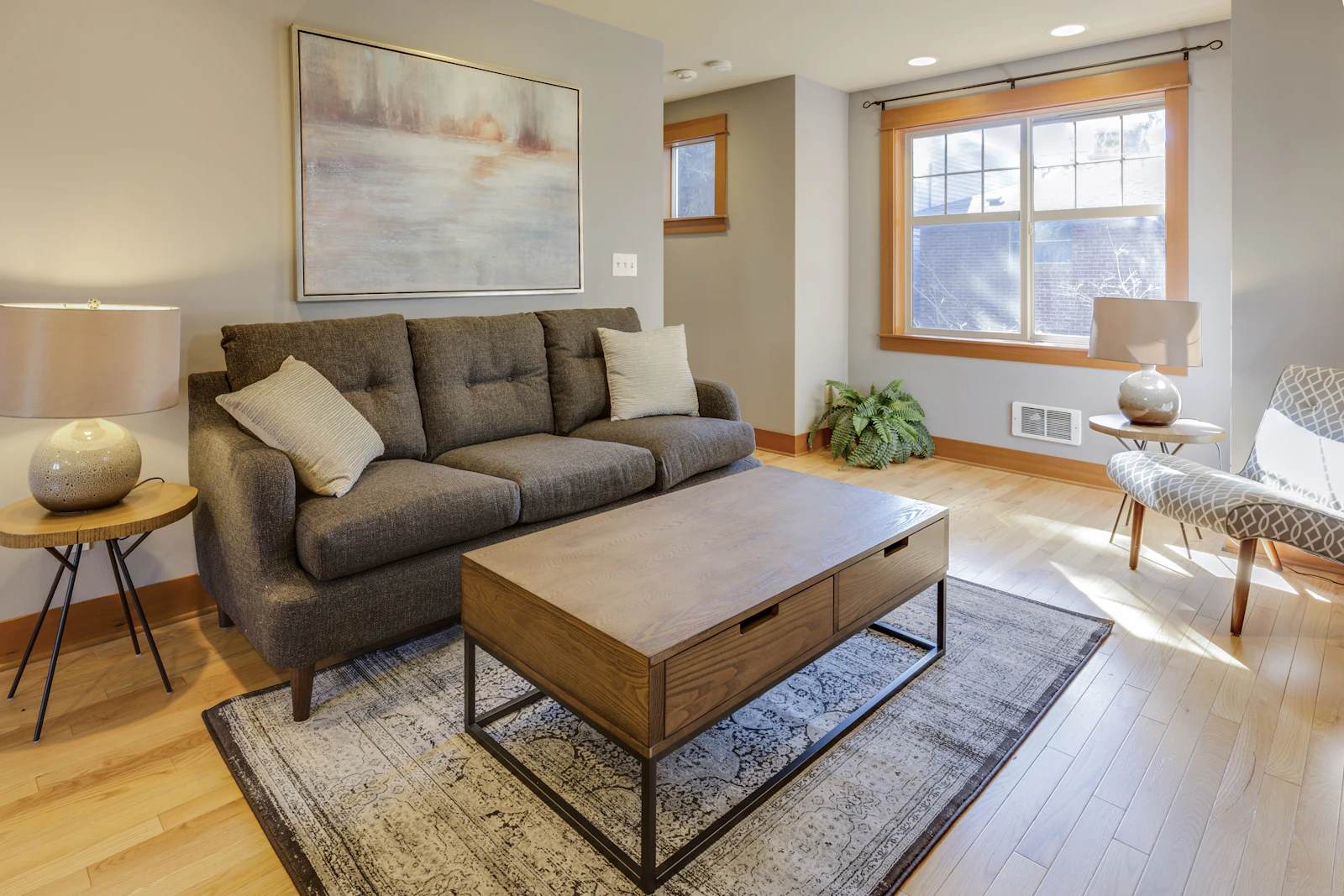
From the outside, two sofas can look almost identical in a shop and differ enormously in how they feel after a few years. The difference lies in parts you cannot see: the frame, the springs and the cushion cores. Add the right dimensions for your body and your room, a fabric suited to how you live, and a delivery route you have actually measured, and you will avoid the most common sofa regrets.
This guide works through each decision in the order that matters: size and fit first, because a sofa that does not suit your room or body is wrong however well it is made; then construction; then upholstery.
Start with how you sit
Before looking at styles, decide what the sofa is mainly for. A sofa for upright conversation and occasional TV needs different proportions from one where two people stretch out every evening. Ask yourself:
- How many people sit on it at once on a normal evening, and how many on busy days?
- Do you sit upright, curl your legs up, or lie down?
- Will anyone use it for naps or as an occasional bed?
- Are there children or pets, and will people eat on it?
- Does anyone in the household find it hard to get up from a low seat?
The answers guide seat depth, seat height, cushion type and fabric more reliably than any style trend.
The dimensions that decide comfort
| Dimension | Typical range | What it affects |
|---|---|---|
| Seat height (floor to top of seat cushion) | 42–46 cm (16.5–18 in) | Ease of sitting down and standing up. Lower feels more relaxed but is harder to rise from. |
| Seat depth (front edge to back cushion) | 50–55 cm upright; 58–65 cm lounging | Whether your feet reach the floor and your back is supported. |
| Overall depth | 85–100 cm (33–39 in) | How far the sofa projects into the room; affects walkways. |
| Back height | 75–90 cm (30–35 in) | Head and neck support; high backs block sightlines in open-plan rooms. |
| Arm height | 55–65 cm (22–26 in) | Leaning comfort; useful for lying down with your head on the arm. |
| Width per seated person | 60–70 cm (24–28 in) | How many people actually fit; a "three-seater" can seat two in reality. |
A simple test: sit with your back against the back cushion. If your knees extend well past the seat edge and your feet dangle or press against the front, the seat is too deep for upright use. If the seat edge stops halfway down your thigh, it is too shallow for lounging. Taller people usually prefer deeper seats and higher backs; shorter people are often more comfortable with seat depths around 50 cm.
Pay attention to arm width too. Chunky arms of 25 cm each can eat 50 cm of width that could otherwise be seating. In a small room, slim arms of 10–15 cm give a more generous seat in the same overall length.
Measure the room and the route
In the room
Mark the sofa's full footprint with masking tape, including its depth. Check that main walkways stay at 80–90 cm (32–36 in) and that the coffee table can sit 40–45 cm from the seat edge. As a rule of thumb for proportion, a sofa usually looks right when it occupies around two-thirds of the wall it sits against, leaving space for a side table or lamp at one or both ends. Our guide to arranging living room furniture covers layout in more detail.
On the way in
Many sofas fail at the front door, not in the living room. Measure every point on the delivery route:
- Width and height of each doorway, measured inside the frame with the door open. Remove the door from its hinges if necessary; it often gains 3–5 cm.
- Hallway width, especially where you need to turn into a room.
- Stair width, headroom above the stairs and any landing turns.
- Lift internal dimensions in flats, including diagonal depth.
Then compare with the sofa. Most sofas pass through a door on their back or side, so the critical figures are the sofa's overall depth and its height. If either is smaller than the door width, the sofa can usually go through tilted. Ask for the diagonal depth, measured from the top back corner to the front edge of the seat; this is the true clearance needed when a sofa is tipped through a doorway. Removable legs, bolt-on arms and modular sections make difficult routes far easier.
What is inside: frame, suspension and fill
The frame
The frame determines how long a sofa keeps its shape. Kiln-dried solid hardwood, such as beech or oak, is strong and stable. Good-quality engineered wood like multi-layer plywood is also durable and is widely used in well-made sofas. Particleboard, chipboard and thin MDF are cheaper and can crack or loosen under repeated stress, particularly at the arms and corners.
Joints matter as much as material. Look for frames that are glued and dowelled, screwed, or reinforced with corner blocks. Staples alone are a sign of a lower-cost build. A quick shop test: lift one front corner about 15 cm off the floor. The other front leg should rise almost at the same time. If the frame twists and the other leg stays on the floor, it lacks rigidity.
Suspension
- Sinuous (serpentine) springs: S-shaped steel springs running front to back. Common, supportive and space-saving; quality depends on spring gauge and spacing.
- Eight-way hand-tied springs: traditional coil springs tied by hand in eight directions. Very comfortable and durable, but expensive and less common.
- Pocket springs: individual coils in fabric pockets, sometimes built into the seat platform or the cushions. They spread weight evenly and give a responsive feel.
- Elastic webbing: rubber or fabric straps stretched across the frame. Lighter and often used in slim, modern designs; good webbing can be comfortable, but cheap webbing can sag.
Press firmly on the seat platform with the cushions removed. You should feel even, springy resistance rather than individual hard points or a hammock-like dip.
Cushion fill
| Fill | Feel | Maintenance |
|---|---|---|
| High-resilience foam | Firm, supportive, keeps a tailored shape | Low; flip and rotate occasionally |
| Foam wrapped in fibre or feather | Supportive with a softer surface | Low to medium; plump the wrap |
| Feather and down | Soft, relaxed, sink-in comfort | High; plump daily, flattens over time |
| Fibre (polyester) | Soft, inexpensive, hypoallergenic alternative to feather | Medium to high; can clump and flatten |
| Pocket-sprung cushion | Bouncy and resilient | Low; heavier cushions |
Foam quality is often stated as density in kilograms per cubic metre. Higher densities generally last longer before softening; seat foams below about 25 kg/m³ tend to lose their shape quickly, while better seats typically use around 30 kg/m³ or more. Ask the retailer if it is not listed. Replaceable cushion cores are a sign that a sofa has been designed to last.
Choosing the upholstery
Fabric durability and rub counts
Fabric durability is commonly measured by the Martindale test, which rubs the fabric until it shows visible wear. The number of cycles gives a useful comparison:
| Martindale rubs | Typical suitability |
|---|---|
| 10,000–15,000 | Light domestic use: occasional chairs, cushions |
| 15,000–25,000 | General domestic use: a sofa used regularly by adults |
| 25,000–40,000 | Heavy domestic use: everyday family sofa, children and pets |
| 40,000+ | Very heavy duty, often specified for commercial seating |
Rub count measures only abrasion. It does not tell you how a fabric pills, fades in sunlight or responds to spills, so consider those separately. In the US, the Wyzenbeek "double rubs" test is more common and uses a different method, so the numbers cannot be compared directly.
Fibre types
- Cotton and linen: breathable, natural and pleasant to touch. Linen creases and can shrink if washed, so dry-cleaning or a pre-shrunk fabric is wise for removable covers.
- Wool and wool blends: resilient, naturally somewhat resistant to soiling and comfortable across seasons.
- Polyester, acrylic and olefin: durable, colourfast and widely used in performance fabrics.
- Velvet: rich colour and soft touch. Synthetic velvets are often more hard-wearing than cotton velvet and less prone to marking.
- Performance fabrics: fabrics engineered or treated to resist stains and water. Check the care label: some can be cleaned with water, others only with solvent cleaners.
Leather
Full-grain and top-grain leathers are the most durable and develop a patina with use. Corrected or pigmented leather has a coated surface that resists stains and is easy to wipe, but it looks more uniform. Bonded leather, made from leather fibres glued to a backing, can peel and is generally best avoided for a sofa in daily use.
Removable covers and colour
Removable covers make cleaning much easier and allow a change of colour later. Mid-tones and fabrics with a little texture or a fleck hide marks better than very pale or very dark plain colours. For how a sofa fits a lasting colour scheme, see our guide to choosing a colour palette.
Sofa, sectional or modular?
- Standard sofa: the most flexible choice if you move house often, and easiest to deliver. Pair with armchairs for more seating.
- Chaise sofa: adds a lounging space at one end. Check whether the chaise can be swapped to either side, which matters if you move.
- Corner or L-shaped sectional: seats more people along two walls or defines a zone in open-plan rooms. The corner seat is often the least comfortable, as knees collide; allow at least 90–100 cm along each side of the corner.
- Modular: separate units that can be rearranged and carried in individually. Ideal for awkward delivery routes, but check how units connect so they do not drift apart.
How to test a sofa in a showroom
- Sit for at least ten minutes in the position you normally use at home.
- Try the middle seat and the corner seat, not only the end.
- Stand up without using your hands; notice whether the seat height suits everyone in the household.
- Remove a seat cushion to check the platform and the label for foam density or fill.
- Lift a corner to check frame rigidity.
- Ask for the frame material, suspension type, fabric rub count and warranty terms in writing.
Common mistakes
- Choosing by looks alone. A deep, low sofa can photograph beautifully and be uncomfortable for upright sitting.
- Not measuring the delivery route. Check every door and stair, not only the front door.
- Buying too small for the room. A short sofa on a long wall looks lost and seats fewer people than expected.
- Picking delicate fabric for heavy use. Match rub count and cleanability to children, pets and food.
- Ignoring the arm width. Wide arms can reduce seating by a whole person.
- Overlooking lead times. Made-to-order sofas often take several weeks or months.
Sofa buying checklist
- Seat height 42–46 cm, seat depth matched to how you sit.
- Footprint taped out; walkways still 80–90 cm.
- Doors, hallways, stairs and lifts measured against depth, height and diagonal depth.
- Hardwood or quality plywood frame with reinforced joints.
- Even, springy suspension and cushion fill suited to your maintenance tolerance.
- Fabric of at least 25,000 Martindale rubs for daily family use.
- Removable or replaceable covers and cushion cores if possible.
- Warranty and delivery details confirmed in writing.
Once the sofa is chosen, size the rug and table around it with our rug size guide and the rug size calculator.
Frequently asked questions
What is a good seat depth for a sofa?
For upright sitting and easy standing, a seat depth of 50–55 cm (20–22 in) suits most adults. If you like to curl up or lounge, look for 58–65 cm (23–26 in). Taller people generally prefer deeper seats, while shorter people and older users often find shallower seats more comfortable because their feet stay on the floor.
What rub count does a sofa fabric need?
For a sofa in everyday family use, look for a Martindale rating of at least 25,000 rubs. Fabrics rated 15,000–25,000 suit general domestic use with lighter wear, and anything above 40,000 is considered very heavy duty. Rub count measures abrasion only, so also consider pilling, fading and how easy the fabric is to clean.
Are feather-filled cushions better than foam?
They are different rather than better. Feather cushions feel soft and relaxed but need plumping every day and flatten over time. High-resilience foam keeps its shape and needs little maintenance but can feel firm. Foam wrapped in a feather or fibre layer is a popular compromise, offering structure with a softer surface.
How do I know a sofa will fit through my door?
Measure the width and height of every door, hallway and stair turn on the route, then compare them with the sofa's depth, height and diagonal depth. If the sofa's depth or height is smaller than the door width, it can usually be carried through on its side. Check whether the legs or back can be removed, and ask the retailer for the packaged dimensions.
How long should a good sofa last?
Lifespan depends on construction and use. A sofa with a solid or engineered hardwood frame, good suspension and replaceable cushion cores can last many years and can often be reupholstered. Sofas with low-density foam and particleboard frames tend to sag much sooner, especially with daily heavy use.
Measurements and rules of thumb in this guide are starting points; always check your own room, local building rules and manufacturer instructions. Images are illustrative, from Unsplash. Read how we research and update our guides in our Editorial Policy, and tell us if you spot an error.