How to Choose Kitchen Countertops: Materials Compared
A worktop is the hardest-working surface in the home and one of the most expensive to replace. This guide compares the main materials honestly, explains what each one tolerates and how to test a sample before you commit.
Choosing a worktop is mostly a question of trade-offs. The material that shrugs off a hot pan may stain from a splash of oil; the one that never stains may scratch; the one with the warmest look may need oiling every few weeks. There is no perfect surface, only one that suits the way you cook and how much maintenance you are prepared to do.
Below we compare the most common materials on the five things that matter day to day: heat, stains, scratches, maintenance and relative cost. Prices vary widely by region, slab and fabrication, so costs are given as a relative scale rather than as figures.
Start with how you cook
Before looking at samples, be honest about your habits. Three questions narrow the field quickly.
- Do you put hot pans straight down? If so, avoid materials with resin or plastic in them, such as engineered quartz, laminate and solid surface, or plan a heat-proof section next to the hob.
- Do you cook with a lot of acid, oil and colour? Tomato, citrus, wine, turmeric and oil are hard on porous and acid-sensitive stones, especially marble and limestone.
- How do you feel about wear? Some people enjoy a surface that records its history. Others want the worktop to look the same in ten years. Neither is wrong, but it rules out materials quickly.
The main materials, one by one
Engineered quartz
Quartz worktops are made mostly from crushed quartz bound with resin and pigment. The result is non-porous, so it does not need sealing and resists most stains, and the pattern is consistent from slab to slab. The weakness is heat: the resin binder can discolour or crack if a very hot pan is put straight on it, so trivets are essential. Some quartz can also yellow in strong sunlight over time, which matters near a large south-facing window or outdoors. Cutting engineered stone releases fine silica dust, and several countries have restricted or banned high-silica products because of the risk to fabricators, so ask the supplier how it is made and cut.
Granite
Granite is a hard natural igneous stone with excellent heat and scratch resistance. Porosity varies a great deal between types: dense, dark granites barely absorb anything, while some paler ones need sealing every year or two. Each slab is unique, so choose the actual slab if you can, not a small sample. Granite feels cold and solid, and its weight means base cabinets must be level and sturdy.
Marble
Marble is softer than granite, made mostly of calcite, and reacts with acids. Lemon juice, vinegar, wine and some cleaning products leave dull etch marks, even through a sealer, because the acid attacks the stone itself rather than staining it. Many people accept this as patina, as you see in old bakeries and bars. A honed (matt) finish disguises etching much better than a polished one.
Quartzite
True quartzite is a metamorphic stone formed from sandstone. It is often harder than granite, resists heat and does not etch, and many types have the soft veining people love in marble. It still needs sealing, and it is expensive and hard to cut. Be aware that some stones sold as "soft quartzite" are actually marble or dolomite. Ask whether it etches with lemon juice and whether it scratches glass; true quartzite does not etch and will scratch glass.
Laminate
Laminate is a printed decorative layer bonded to a particleboard or MDF core. It is the most affordable option, light and easy to fit, and modern versions are much more convincing than older ones. It does not tolerate heat or knives, and water that gets into joints, cut-outs or chipped edges can swell the core. It cannot really be repaired, so damage usually means replacement of that length.
Solid wood
Wood worktops, usually oak, walnut, beech or iroko, bring warmth and are pleasant to work on. Scratches and small burns can be sanded out, which makes wood one of the few surfaces you can renew. The cost is maintenance: wood needs oiling frequently at first, often monthly in the first months and then a few times a year, and standing water around a sink will blacken it if the oil wears thin. Many kitchens use wood on an island or a run away from the sink and stone or steel elsewhere.
Porcelain and sintered stone
Porcelain and sintered stone are made by fusing minerals at very high temperature. They are highly resistant to heat, stains, scratches and UV light, which also makes them suitable outdoors. Slabs are often thin, around 12 mm (1/2 in), which gives a sleek edge. The weak point is the edge itself, which can chip if struck by a heavy pan, and on some products the pattern is printed on the surface only, so a chip shows a different colour underneath. Fabrication is specialist work.
Stainless steel
Steel is heat-proof, hygienic and seamless when welded, which is why professional kitchens use it. It scratches from the first day and gradually develops a soft, even patina; it can also dent and shows fingerprints. A thicker gauge on a solid backing feels quieter and more solid.
Concrete
Concrete can be cast to any shape and colour, with integrated sinks and drainers. It is porous, so it needs a good sealer and periodic resealing, and acids can etch it. Hairline cracks can appear as it cures, which some see as character. It is heavy and the result depends heavily on the skill of the maker.
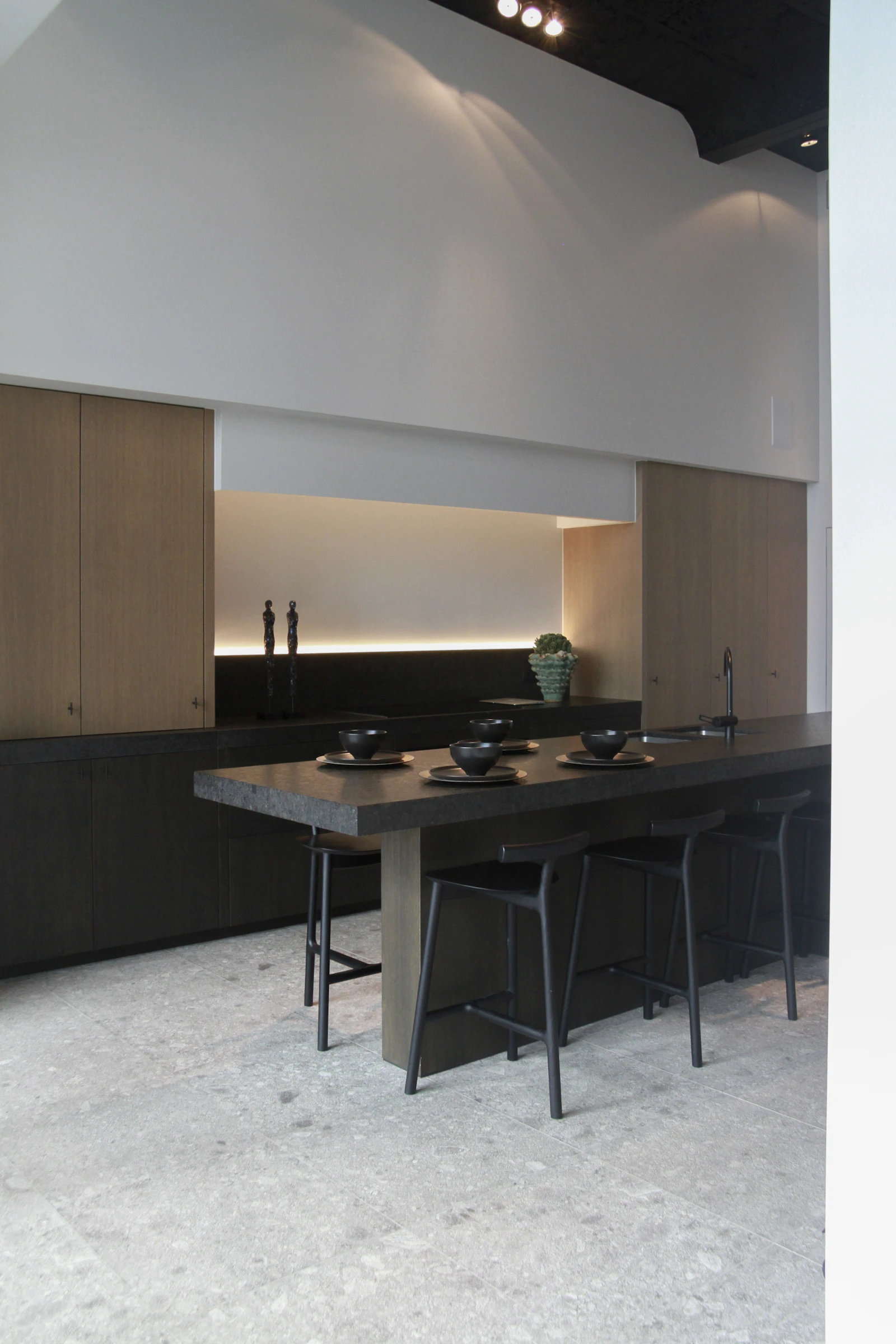
Countertop materials compared
The ratings below are general guidance for typical products; individual slabs and brands vary. "Relative cost" includes typical fabrication and fitting.
| Material | Heat | Stains | Scratches | Maintenance | Relative cost |
|---|---|---|---|---|---|
| Engineered quartz | Fair (use trivets) | Very good | Good | Low | £££ |
| Granite | Very good | Good when sealed | Very good | Low to medium (seal every 1–2 years) | ££–£££ |
| Marble | Good | Poor (etches with acid) | Fair | High | £££–££££ |
| Quartzite | Very good | Good when sealed | Excellent | Medium | ££££ |
| Laminate | Poor | Good | Poor | Low | £ |
| Solid wood | Poor to fair | Fair | Fair (can be sanded) | High (regular oiling) | ££ |
| Porcelain / sintered stone | Excellent | Excellent | Very good (edges can chip) | Very low | £££–££££ |
| Stainless steel | Excellent | Very good | Poor (develops patina) | Low | £££ |
| Concrete | Good | Fair when sealed | Good | Medium to high | £££ |
Finish, thickness and edges
Polished, honed or textured
The same stone behaves differently depending on its finish. A polished surface reflects light, looks deeper in colour and resists staining slightly better because the pores are tighter, but it shows etching, scratches and water marks clearly. A honed (matt) surface hides wear and etching, though it can show greasy fingerprints on dark stones. Leathered or brushed textures disguise almost everything and feel pleasant to the touch, but crumbs can sit in the texture.
Thickness
Stone and quartz slabs usually come in 20 mm or 30 mm (about 3/4 or 1 1/4 in). The thicker slab looks more substantial and allows a longer unsupported overhang for a breakfast bar, but it is heavier and costs more. A 30 mm granite top weighs roughly 80 kg per square metre (about 16 lb per square foot), so the cabinets and floor must be sound. Laminate is typically 38–40 mm (1 1/2 in) and wood 27–40 mm (1–1 1/2 in).
Overhangs and edges
A worktop normally projects 2–3 cm (about 1 in) beyond the cabinet doors so drips fall on the floor rather than down the fronts. For seating, you need 25–30 cm (10–12 in) of overhang; ask your fabricator how far the chosen material and thickness can extend without brackets. A small radius or bevel on the edge resists chipping far better than a sharp square edge, which matters most on porcelain and quartz.
How to test a sample before you buy
Showroom samples are clean and perfectly lit. A simple test at home tells you much more.
- Get a real sample, ideally an offcut from the same batch, at least the size of a hand.
- Apply the usual suspects: a drop each of olive oil, lemon juice, red wine, coffee and turmeric paste. Leave them for an hour and then overnight.
- Wipe with your normal cleaner and look at the sample at an angle under a lamp, where etching and dull patches show.
- Try a scratch test on the back or an edge using a key or a ceramic mug base.
- Check it in your light. Place the sample on the cabinet door you have chosen, near the window and under your evening lighting. Many whites and greys shift colour dramatically between showroom and kitchen.
- Look at a full slab for natural stone, because veining and colour change across its length.
The colour of the worktop also interacts with the rest of the palette; our guide to choosing a colour palette explains how to balance warm and cool tones across cabinets, floors and walls.
Mixing materials
Using two worktop materials is not a compromise, and it is often the most practical answer. A durable, low-maintenance surface such as quartz, granite or porcelain can go around the sink and hob, where water and heat are constant, while a warmer or more delicate material such as wood or marble goes on an island used for serving and eating. Keep the number of materials to two, or three at most, and relate them by colour or tone so the kitchen does not look piecemeal. If your cabinets are wood, our guide on mixing wood tones helps you choose a timber worktop that sits well with them.
Common mistakes
- Choosing from a small sample. Natural stone in particular varies across a slab; a tiny chip says little about the whole.
- Ignoring the sink. An undermount sink needs a solid, water-resistant material; laminate usually needs an inset sink.
- Assuming "stone" means heat-proof. Engineered quartz contains resin. Even natural stone can crack from sudden heat at a cut-out.
- Skipping the sealer schedule. Porous stone and concrete that are not resealed stain slowly and permanently.
- High-gloss in a busy family kitchen. A polished dark top shows every crumb, smear and scratch.
- Forgetting the joints. Ask where seams will fall on an L-shape or a long run; a joint in front of the hob or sink is unsightly and vulnerable.
- Matching the splashback too exactly. A full-height stone splashback looks striking but doubles the material cost; an upstand of 10 cm (4 in) with tiles or paint above is a valid alternative.
Quick decision guide
- Lowest maintenance: porcelain or sintered stone, engineered quartz, stainless steel.
- Best with hot pans: porcelain, granite, quartzite, stainless steel.
- Warmest look and feel: solid wood, honed marble.
- Tightest budget: laminate, then solid wood.
- Most forgiving of wear: stainless steel and honed or leathered stone, because wear blends in.
Before you order
- Your cooking habits are matched to the material's heat and stain tolerance.
- A sample has been tested at home with oil, acid and colour.
- The finish (polished, honed or textured) is chosen with maintenance in mind.
- Thickness, overhangs and any breakfast bar support are agreed with the fabricator.
- Sink type, hob cut-out and joint positions are drawn on the plan.
- The sealing or oiling routine is understood and realistic for you.
- The layout is final: see the kitchen layout guide before templating, because the worktop is measured on site once the cabinets are fitted.
Frequently asked questions
What is the most durable kitchen countertop?
Porcelain and sintered stone resist heat, stains, scratches and sunlight better than most materials, and quartzite and granite are also very hard. No worktop is indestructible: porcelain can chip at the edges and natural stones still need sealing, so durability depends on how you cook as well as on the material.
Is quartz better than granite?
Neither is better in every way. Quartz is non-porous, needs no sealing and has a consistent pattern, but its resin binder can mark if a hot pan is put straight on it. Granite copes well with heat and has natural variation, but most types need resealing every year or two. Choose by how you use the kitchen.
Can you put hot pans on a stone worktop?
Granite and quartzite usually tolerate brief contact with a hot pan, and porcelain is highly heat resistant, but sudden heat can still cause thermal shock or mark a sealer. Engineered quartz, laminate, solid surface and wood can scorch. Using a trivet or board is the safest habit with every material.
How do I know if my stone worktop needs sealing?
Put a few drops of water on the surface and leave them for 10–15 minutes. If the stone darkens under the water, it is absorbing and should be resealed. If the water beads and the stone stays the same colour, the sealer is still working.
Is marble a bad choice for a kitchen?
Marble is beautiful but soft, and acids such as lemon juice, vinegar and wine etch dull marks into it, even when it is sealed. It suits people who like a surface that develops a patina. A honed finish shows etching far less than a polished one.
What thickness should a kitchen worktop be?
Stone and quartz are commonly 20 mm or 30 mm (about 3/4 or 1 1/4 in) thick, laminate around 38–40 mm (1 1/2 in) and solid wood 27–40 mm (1–1 1/2 in). Thicker slabs allow longer unsupported overhangs and look more substantial, but they are heavier and cost more.
Measurements and rules of thumb in this guide are starting points; always check your own room, local building rules and manufacturer instructions. Images are illustrative, from Unsplash. Read how we research and update our guides in our Editorial Policy, and tell us if you spot an error.